Project Overview & My Role
This project began with a workplace problem common to employee survey programs: organizations may invest heavily in collecting and displaying feedback while giving managers limited support for interpreting the results or following through.
I reviewed research on engagement measurement, employee survey follow-up, action planning, HR analytics, and evidence-based HR. From that research, I developed a six-step process for clarifying what a score represents, examining the pattern beneath it, gathering employee context, assigning responsibility, and documenting what happens next.
For the portfolio version, I created a fictional healthcare organization and a synthetic Manager Support scenario. I designed the dashboard, process diagram, and responsibility map to demonstrate how the framework could be applied.
Important note: This was an individual academic capstone. No real organizational data was used, and the process was proposed rather than implemented or evaluated.
A Score Cannot Explain Its Own Cause
Employee survey dashboards can make a result look ready for action, but a score cannot explain what caused the result. Managers still need to understand what the score measures, which items changed, what employee experiences may explain the pattern, and who has the authority to address the issue.
Start by Reading the Pattern
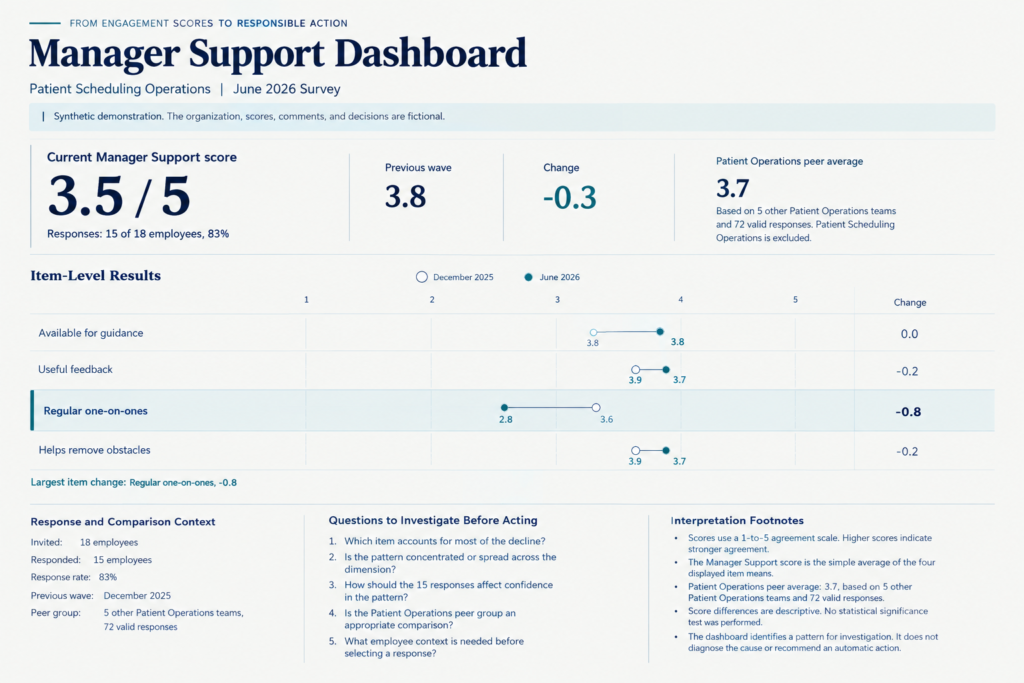
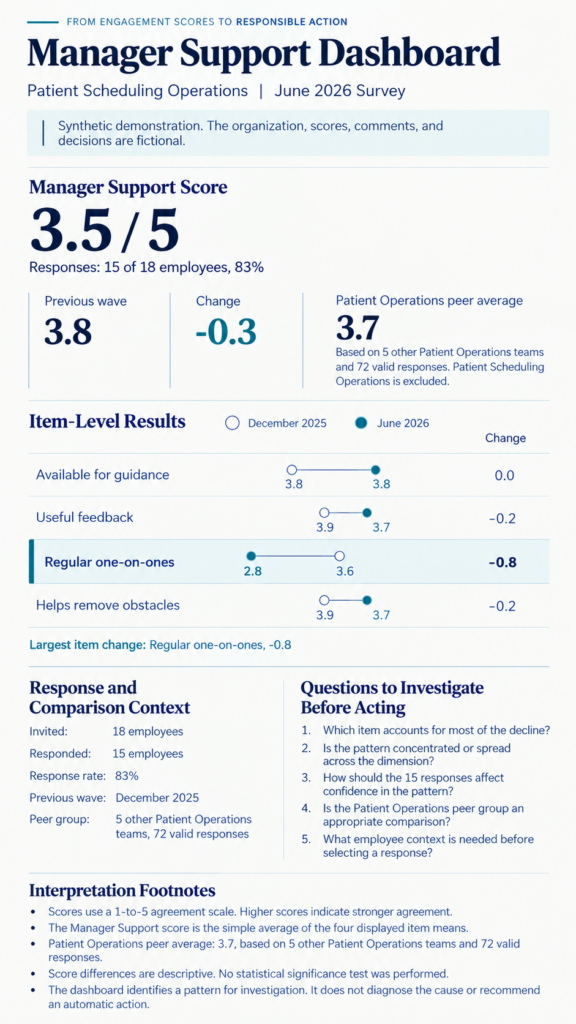
The synthetic Northstar Care Services example begins with a moderate decline in Manager Support. The overall score moved from 3.8 to 3.5, while the largest item-level change appeared in regular one-on-one conversations, which fell from 3.6 to 2.8. Fifteen of eighteen employees responded.
Synthetic dashboard showing where the Manager Support score changed before a manager chooses a response.
From Survey Score to Responsible Action
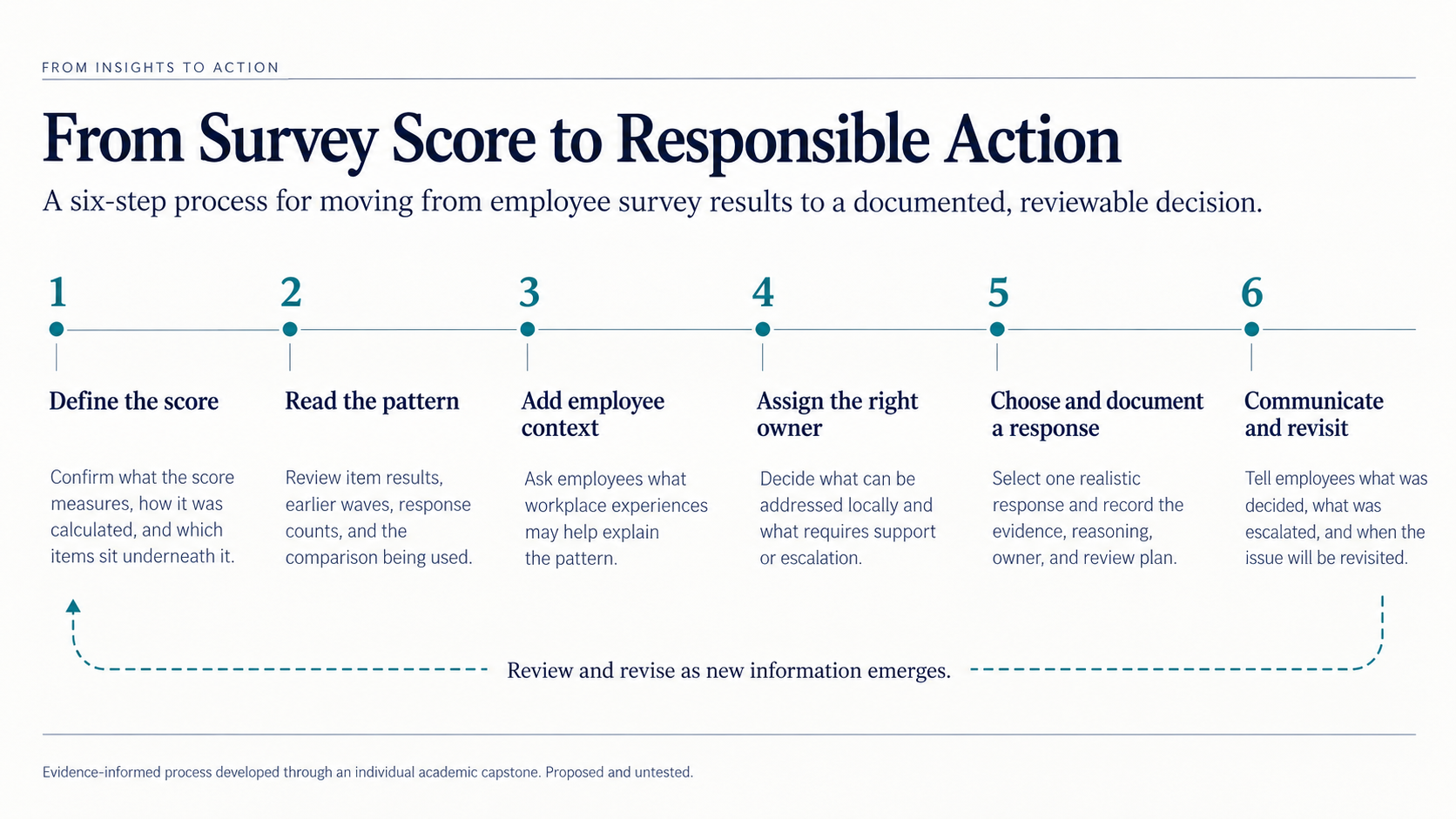
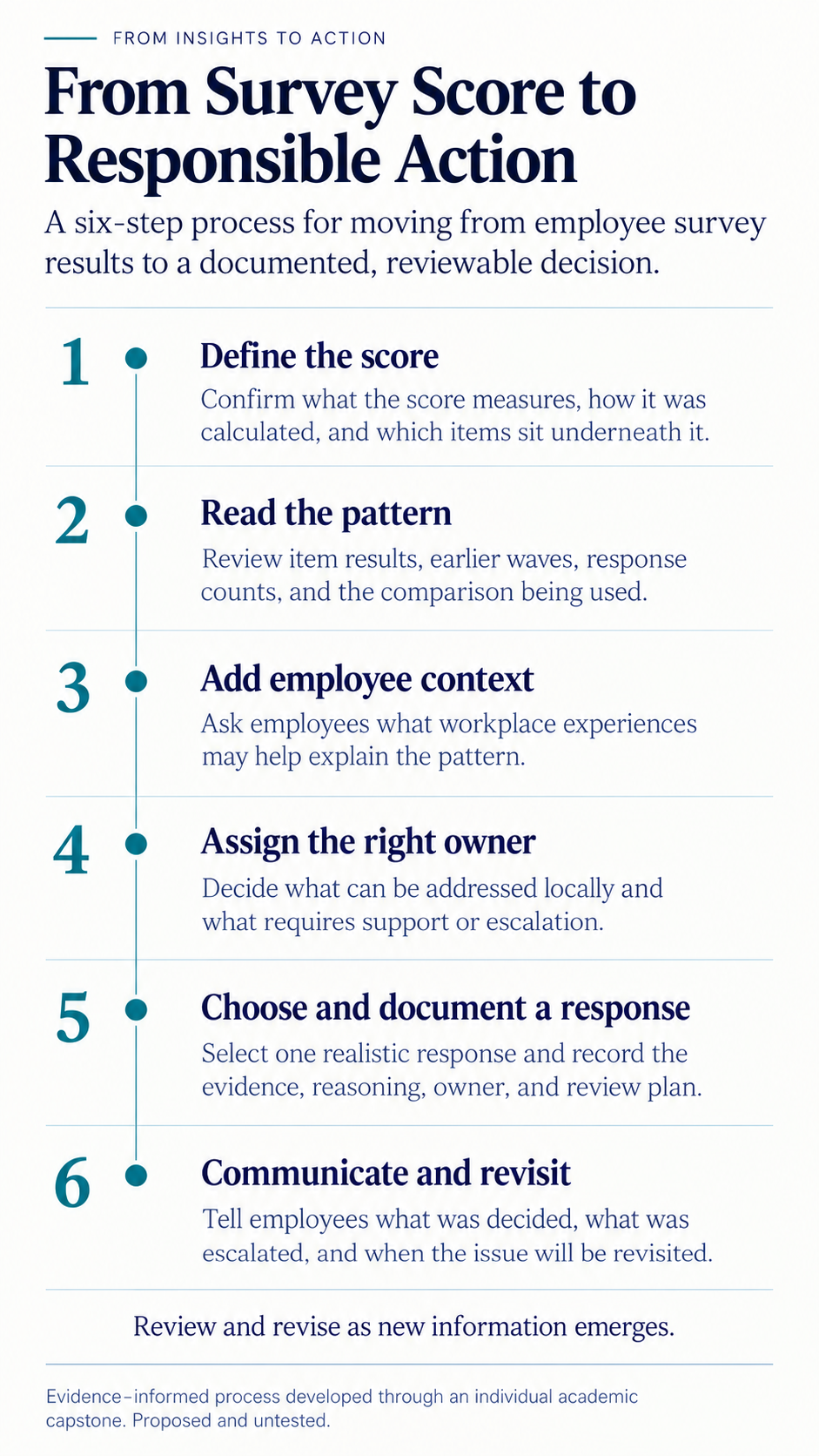
The dashboard begins the investigation. I developed the six-step process to organize what happens next: clarify the measure, read the pattern, add employee context, assign ownership, document a response, and communicate follow-through.
An evidence-informed process for moving from an employee survey result to a documented, reviewable decision.
The process is designed to make the reasoning behind survey follow-through visible. It gives managers a structure for delaying action until the result is understood, bringing employee context into the interpretation, and revisiting the decision when new information emerges. It is evidence-informed, proposed, and untested.
Assign Responsibility Before Promising a Solution
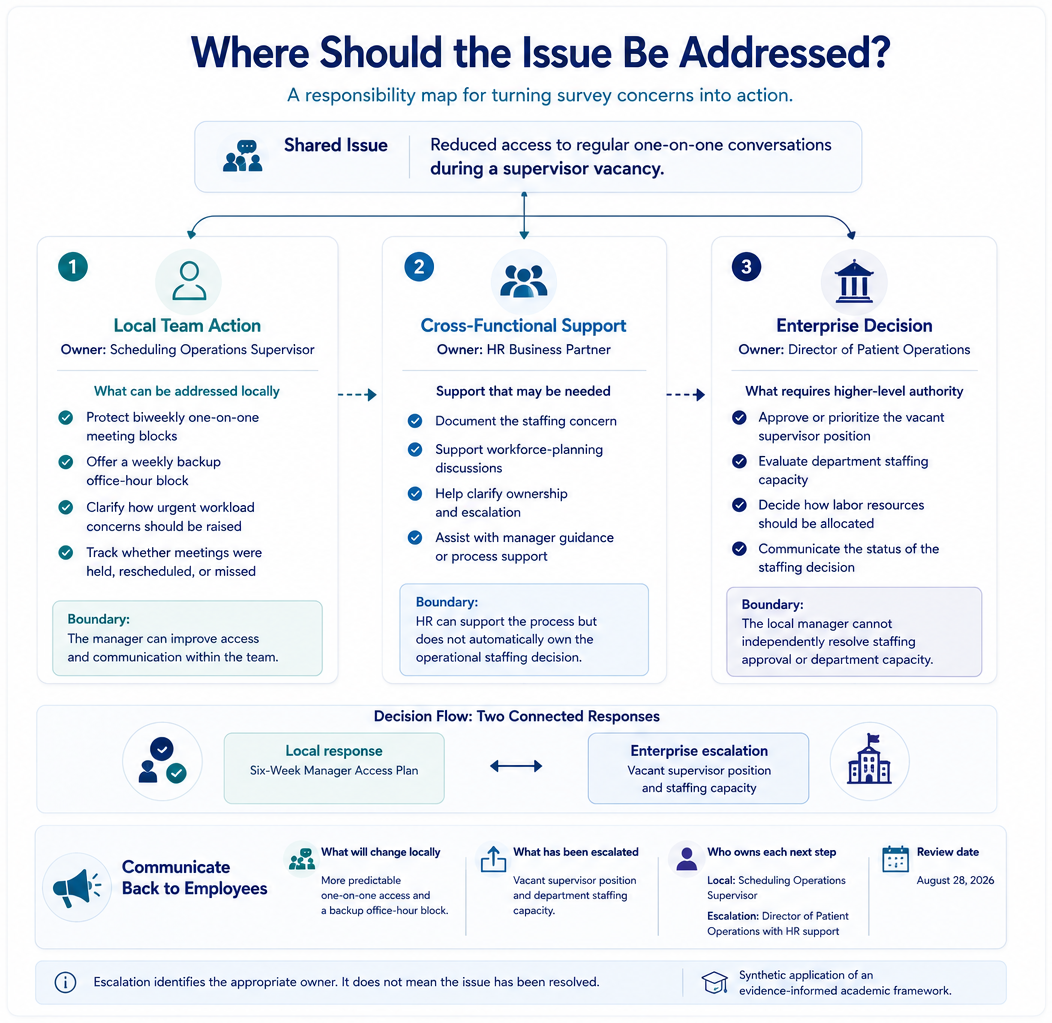
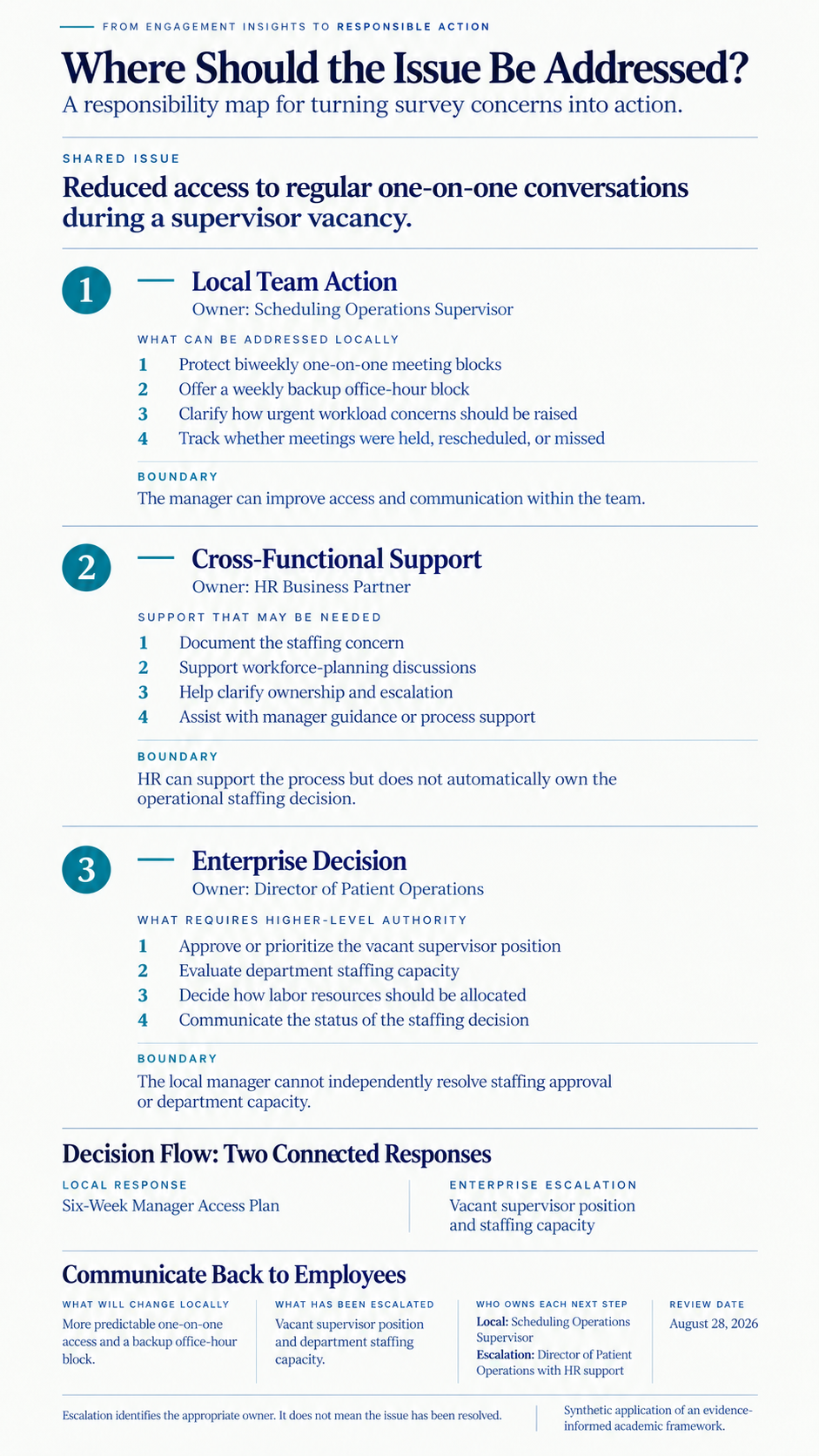
In the synthetic follow-up discussion, employees connect reduced manager access to a vacant supervisor position. Their manager is temporarily covering two teams, causing regular one-on-one meetings to be postponed or cancelled. The concern therefore has both a local component and a staffing component that requires higher-level authority.
The local manager owns the short-term access plan, HR supports the process, and department leadership owns the staffing decision.
The Scheduling Operations Supervisor owns the short-term Manager Access Plan. The HR Business Partner supports documentation and escalation. The Director of Patient Operations owns the staffing-capacity decision. Employees receive an update explaining what will change locally, what has been escalated, who owns each next step, and when the issue will be reviewed.
Evidence & Limits
This process draws on research concerning engagement measurement, employee survey follow-up, topic ownership, HR analytics, and evidence-based HR decisions.
The evidence supports careful construct definition, item-level review, employee involvement, explicit ownership, documented reasoning, and visible follow-through. However, the research on action planning remains limited, so this six-step process should be treated as an evidence-informed, proposed, and untested framework that would still need evaluation in a real organizational setting.
Skills Demonstrated
Final Takeaway
This case study shows how I translate I/O research into practical decision support around employee data. The work combines survey interpretation, research synthesis, employee-listening follow-through, decision-process design, and data storytelling. The goal is to support a decision that can be explained to employees, assigned to the right owner, and reviewed when new information emerges.