SURVEY MEASUREMENT · PSYCHOMETRIC EVALUATION · EMPLOYEE LISTENING
Workplace Boundary Management: From Construct Definition to Evidence-Based Revision
A course-based measurement project showing how I translated a workplace construct into survey items, evaluated the psychometric evidence, and identified what the measure would need before organizational use.
Project Overview & My Role
Workplace Psychological Boundary Management, or WPBM, refers to the everyday behaviors employees use to keep work from spilling into their non-work lives.
I developed the measure as part of an Applied Measurement Theory course project focused on taking an abstract workplace construct through the major stages of scale development.
I defined and revised the construct, developed survey items, incorporated subject-matter expert feedback, finalized a 17-item pre-analysis form, and evaluated the measure using course-based psychometric analyses.
By the end of the project, my focus was on understanding what the evidence actually supported — including where the proposed structure became difficult to defend.
The Measurement Problem
Survey items need to stay focused on the behavior they are intended to measure. If items begin to capture related outcomes such as burnout, work-family conflict, job satisfaction, or detachment, the meaning of the resulting score becomes less clear.
The goal was therefore to define WPBM clearly enough that the survey content reflected boundary-management behavior rather than neighboring workplace experiences.
From Construct to Measure
My first conceptual model combined perceived boundary control, boundary type, and role salience. As I worked through the definition, I concluded that those concepts operated at different levels and did not create a consistent measurement structure.
I revised the working model around three proposed content areas:
Physical — behaviors related to where work occurs
Temporal — behaviors related to when work occurs
Psychological — behaviors related to mentally disengaging from work
Temporal — behaviors related to when work occurs
Psychological — behaviors related to mentally disengaging from work
The resulting pre-analysis form contained 17 items: 5 Physical, 6 Temporal, and 6 Psychological.
At this stage, those categories organized the item content. Their empirical structure still needed to be tested.
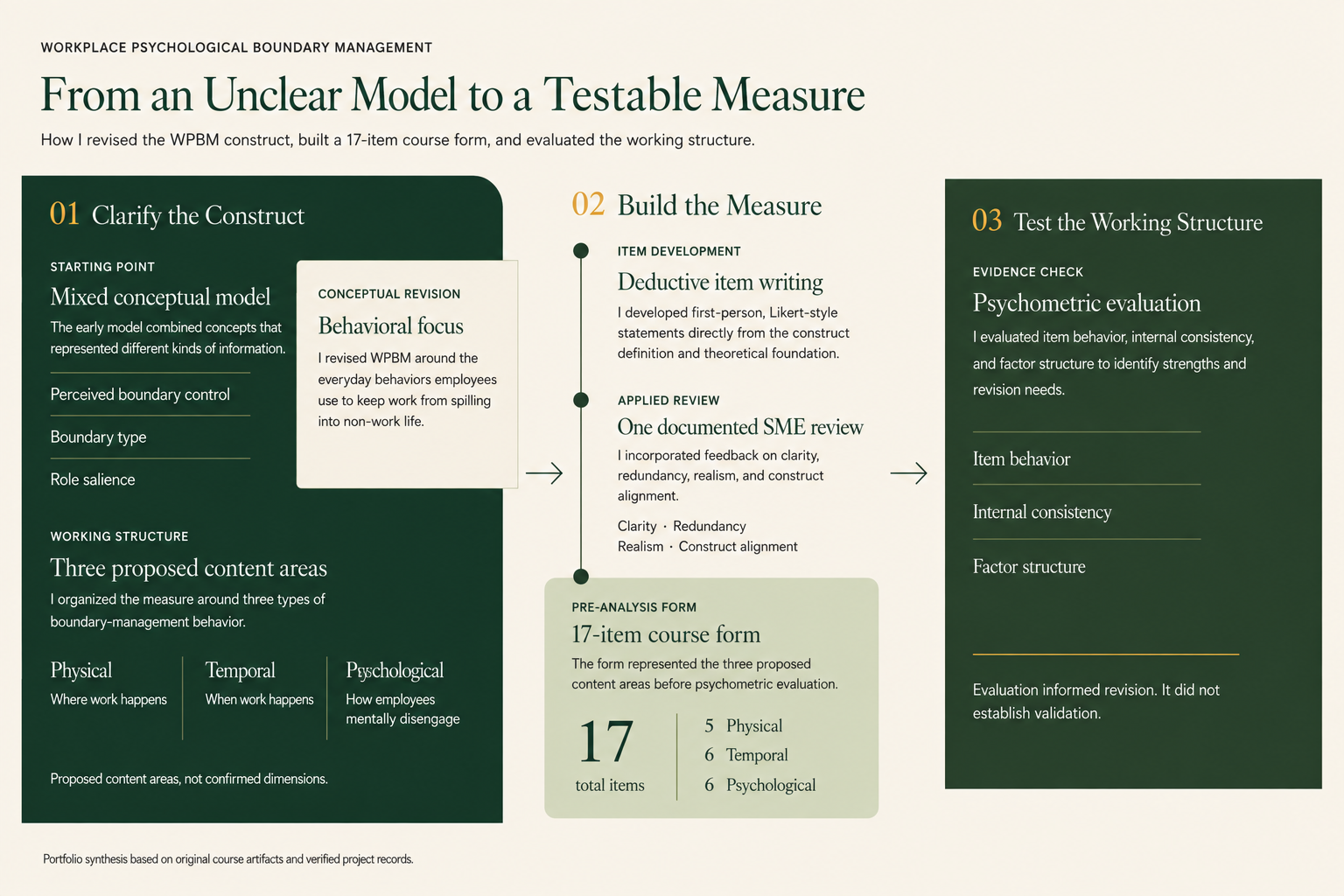
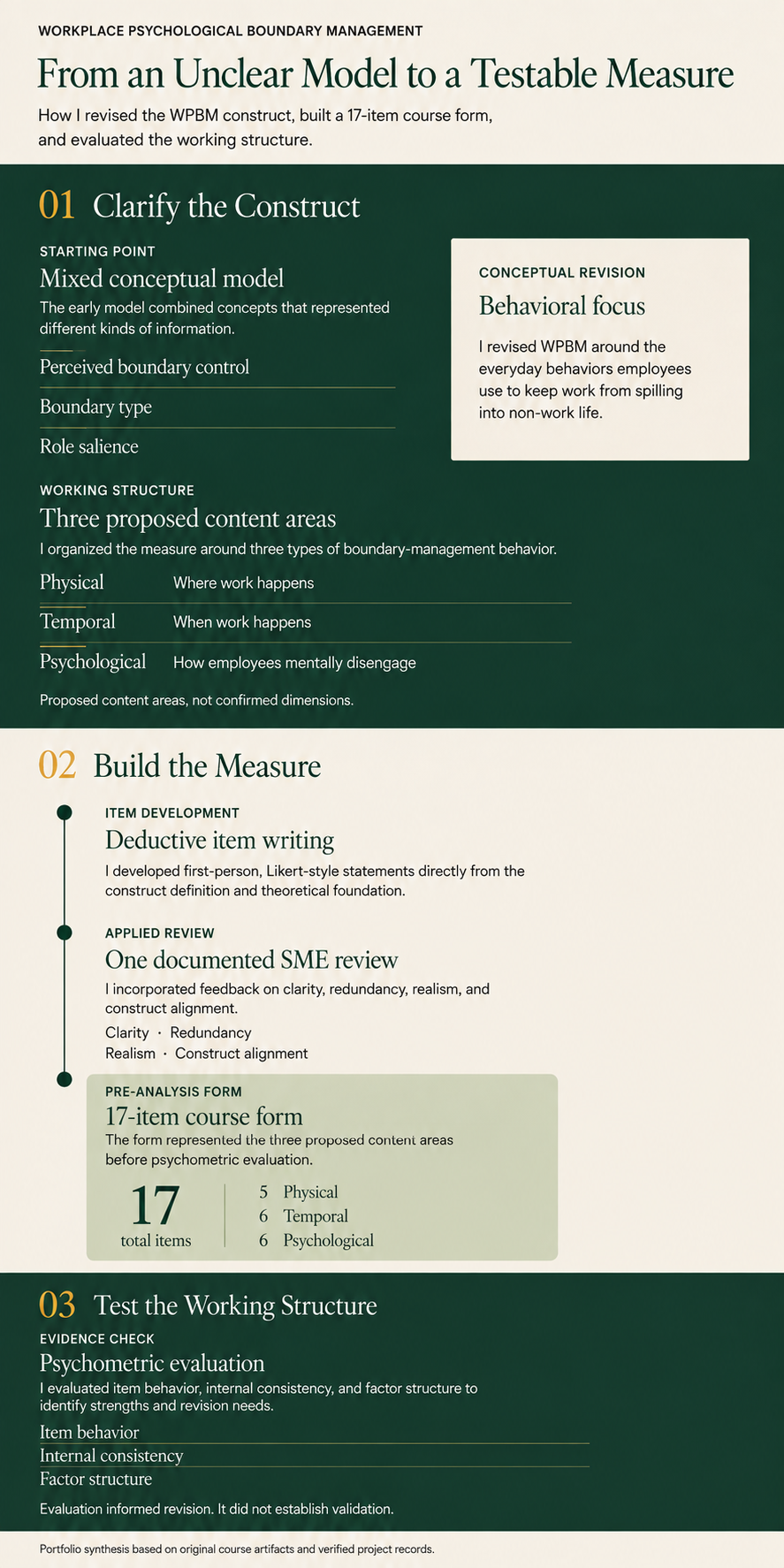
How I moved from an early mixed conceptual model to a 17-item course form organized around three proposed boundary-management areas.
Refining the Items
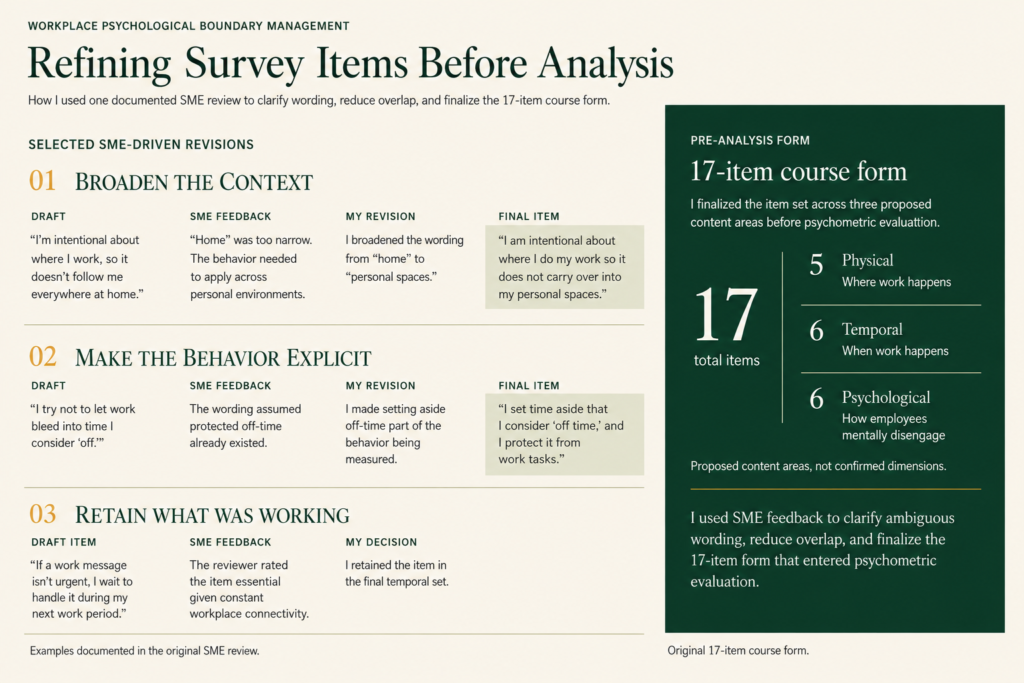
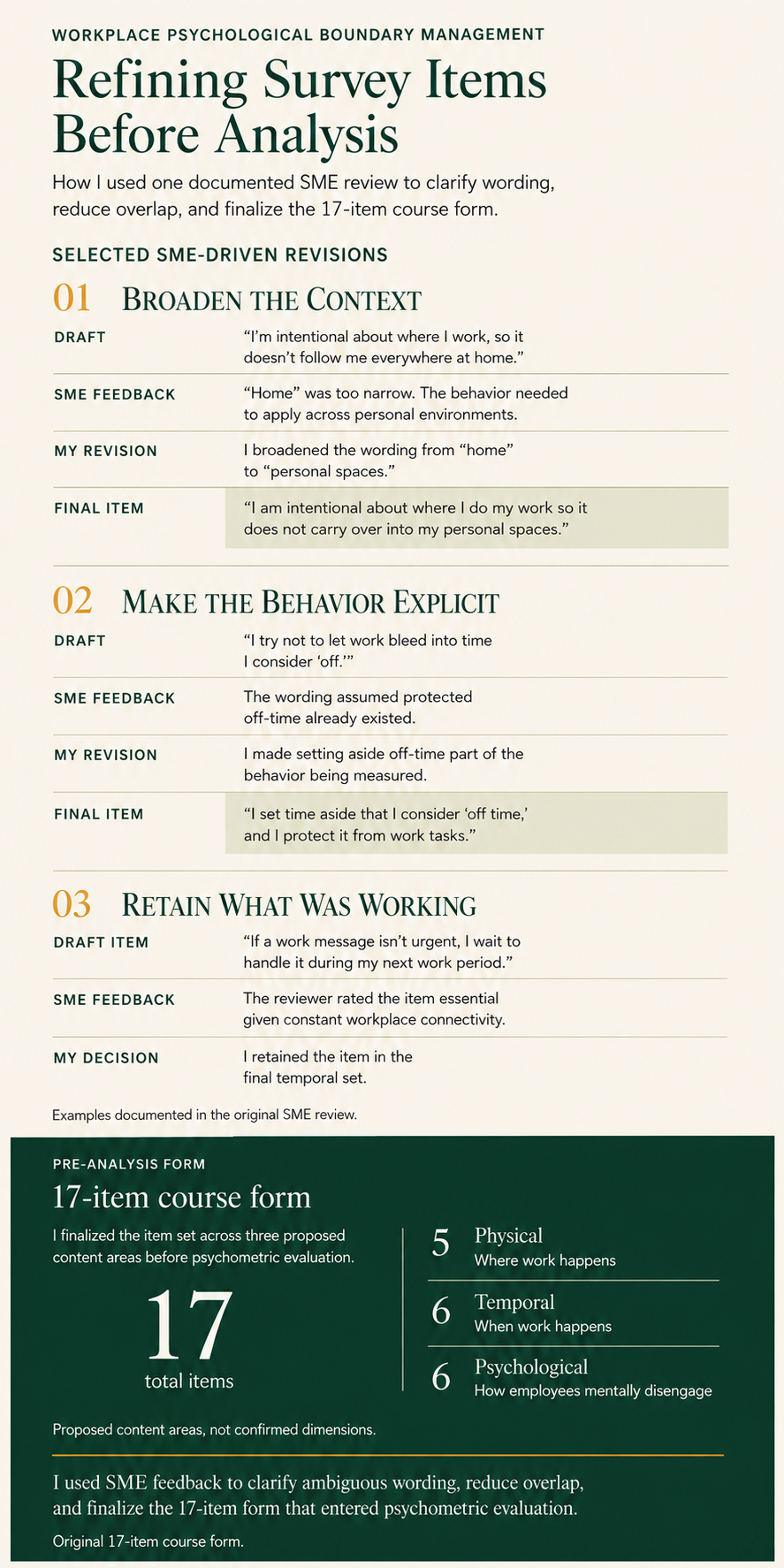
Selected examples of how one documented SME review informed item wording and retention decisions before the 17-item form entered psychometric evaluation.
What the Evidence Showed
The later numerical results are reconstructed from retained course analysis records because the original analysis outputs are no longer available.
The results showed a mixed picture. Internal consistency varied across the proposed areas:
- Physical: α = .62 to .66
- Temporal: α = .82 to .83
- Psychological: α = .72 to .76
Temporal showed the strongest internal consistency, while Physical was weaker.
The factor analysis raised the more important issue. The proposed three-factor model performed better than a one-factor model on most comparative indicators, but absolute fit remained poor. The results did not provide strong support for the proposed three-area structure.
The overlap between Temporal and Psychological was especially important. Their correlation was .934, suggesting that the two proposed areas were extremely difficult to distinguish empirically in the course dataset.
The appropriate conclusion was therefore revision rather than confirmation. The evidence showed where the measure was stronger, where it was weaker, and what would need to be reconsidered in a future validation cycle.
Internal consistency does not establish validity, and a relatively better model is not the same as an adequately fitting model.
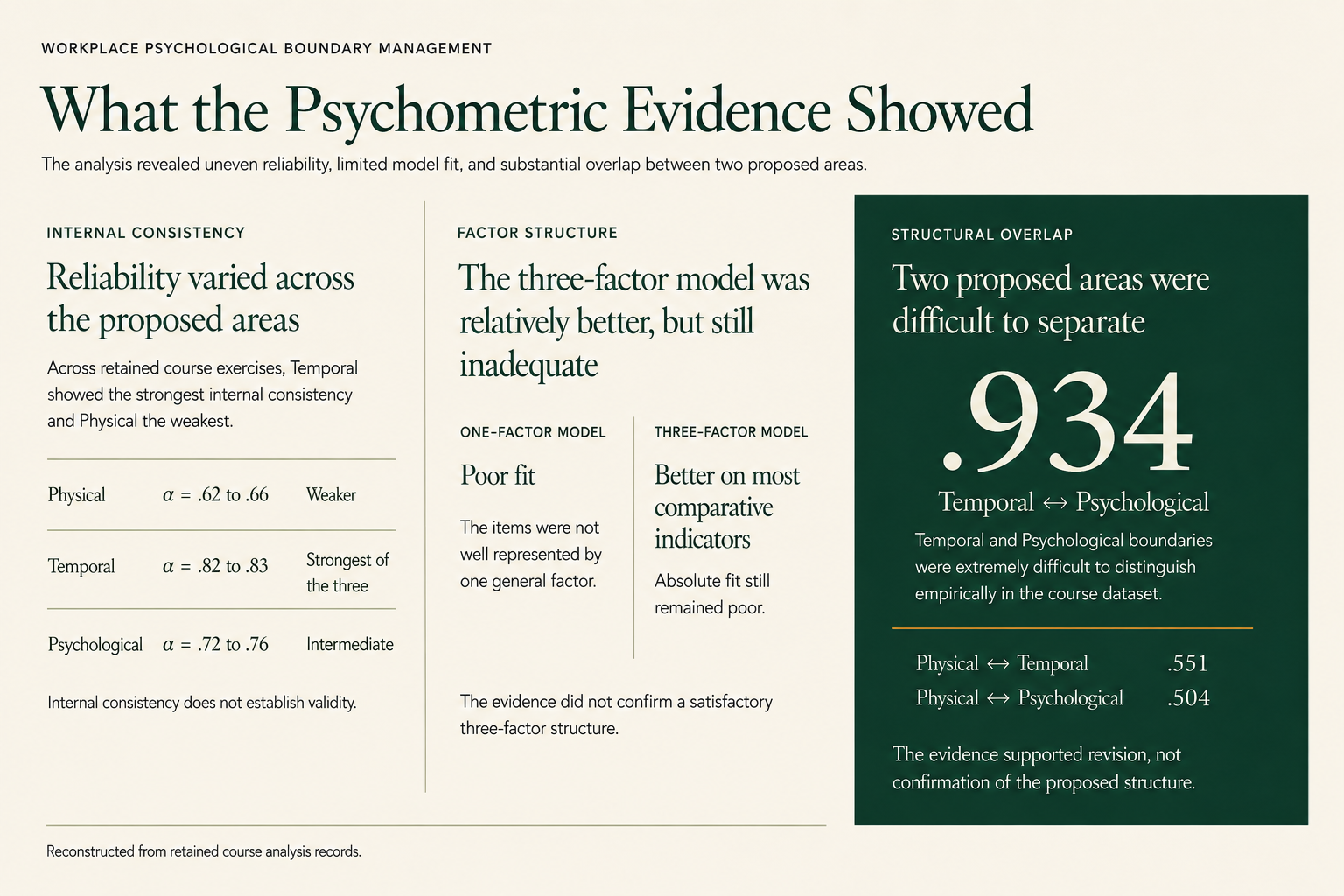
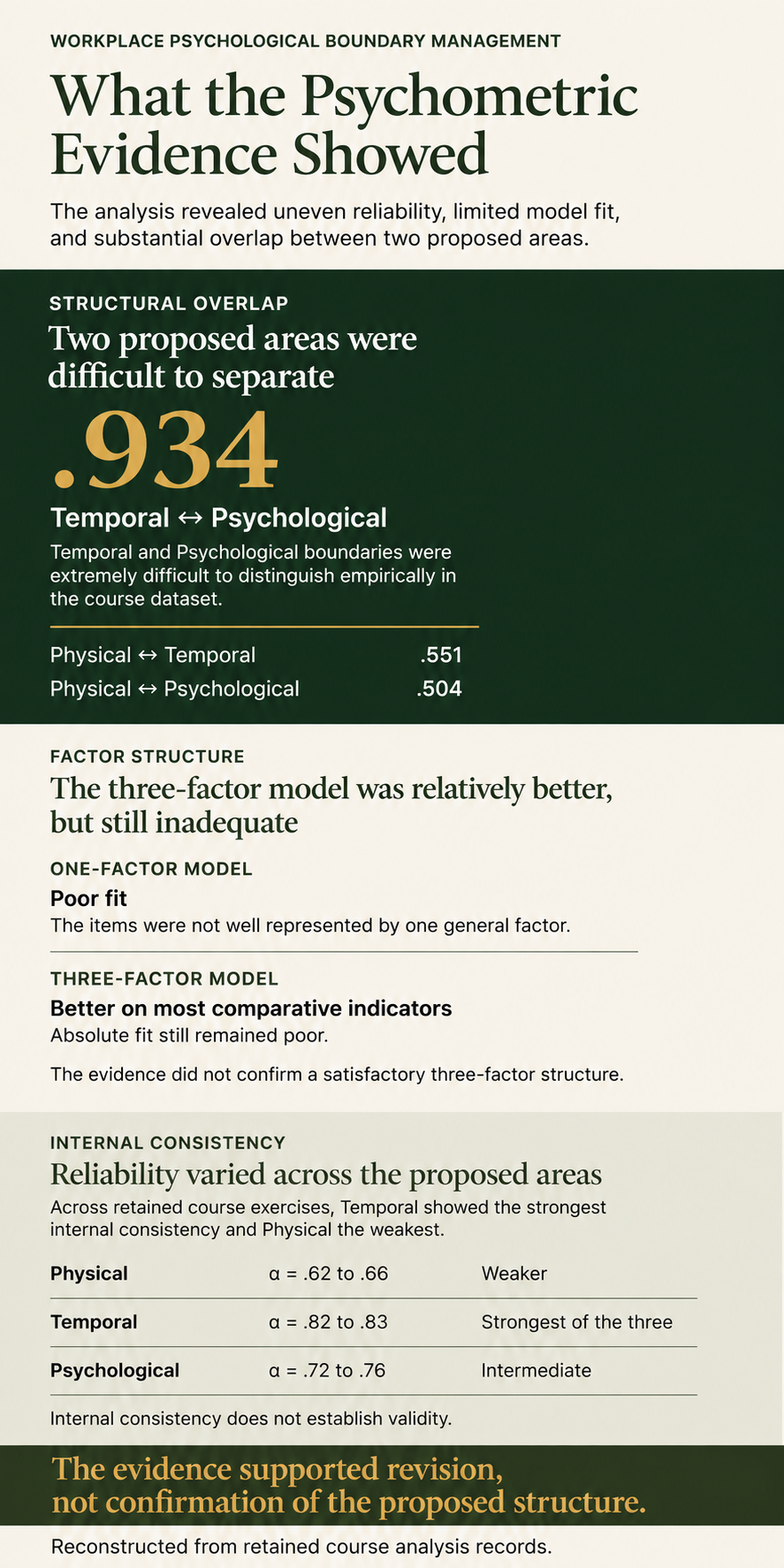
Reconstructed course results showing uneven internal consistency, inadequate factor-model fit, and substantial overlap between Temporal and Psychological boundaries.
What I Would Revise Next
The later analysis identified BOU_2 and BOU_14 as the clearest weak items. BOU_2 may have captured workspace organization more than physical boundary regulation, while BOU_14 may have reflected task management more than psychological disengagement. Both showed weak relationships with their intended scales and very low factor loadings in the retained analysis record.
Removing weak items alone would not resolve the larger conceptual issue. I would revisit the boundary between Temporal and Psychological content and develop revised or replacement items that create a clearer distinction between managing work time and managing work-related thought.
I would then test the revised item pool with a larger and more diverse sample, use exploratory analysis to examine how the items group together, and evaluate the resulting structure in independent data. Criterion relationships and fairness evidence would also need to match the measure’s intended organizational use.
I would want that evidence before recommending score-based decisions or organizational implementation.
Skills Demonstrated
Final Takeaway
The value of this project is the measurement judgment it required, especially recognizing when the evidence did not support the original model.
I translated a workplace concept into survey content, incorporated SME feedback, evaluated measurement quality, and narrowed my conclusions when the results did not support the proposed structure.
My main takeaway is that useful workforce measurement requires judgment about what a score represents and whether the available evidence actually supports interpreting it that way.